Classroom sociogram example, worked through
A class of 16 lower-secondary students from start to finish: what they answered, what the sociogram looks like, what each index says and what the teacher decides to do. Names and data are fictional.
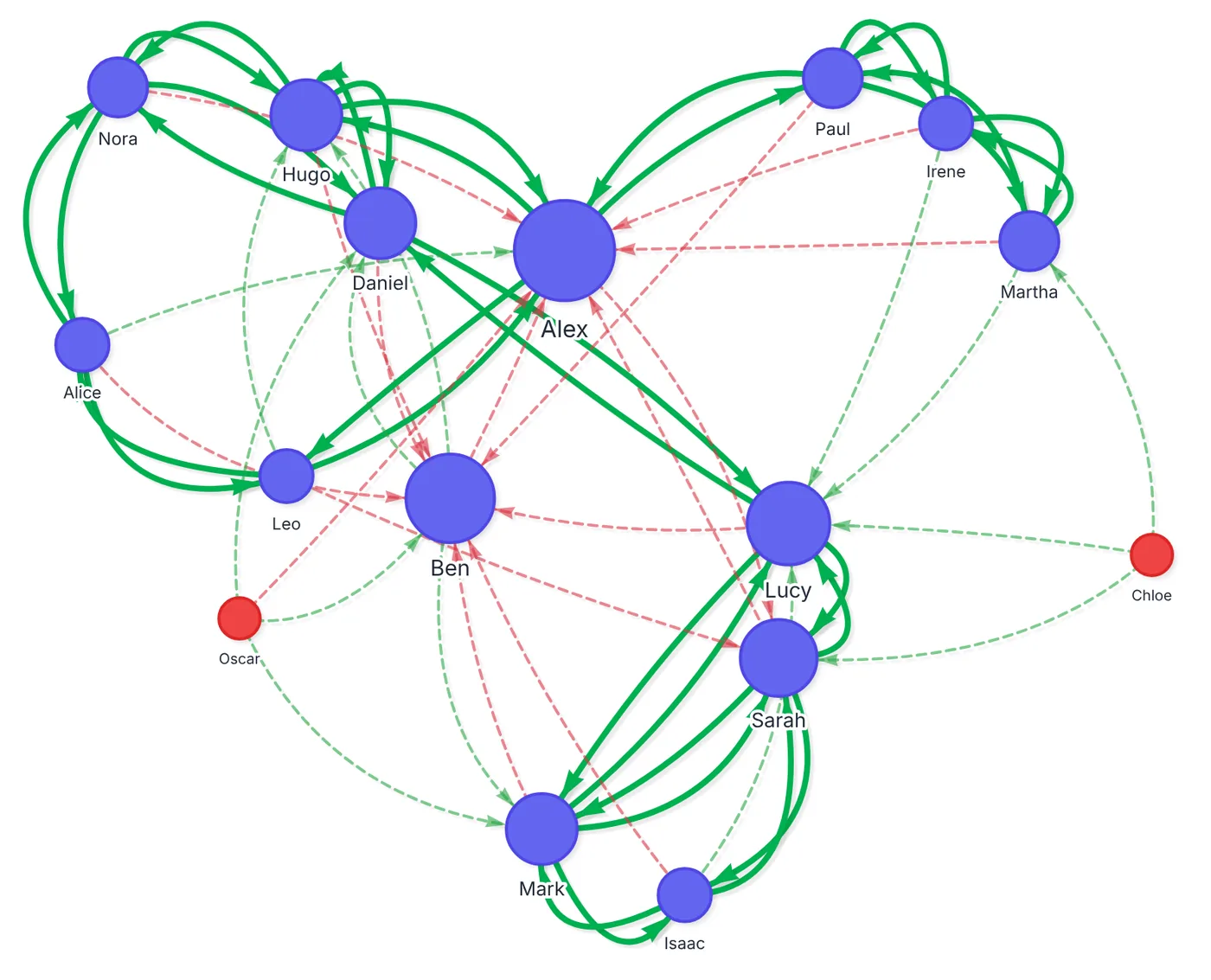
- Three clear subgroups, linked by Lucy, Daniel and Alex.
- Chloe and Oscar receive no choices at all.
- Ben receives 7 rejections out of 15 possible, and none of his choices is returned.
- Alex divides the group: 4 choices and 6 rejections.
- High reciprocity (71%): the ties that exist are stable.
The context
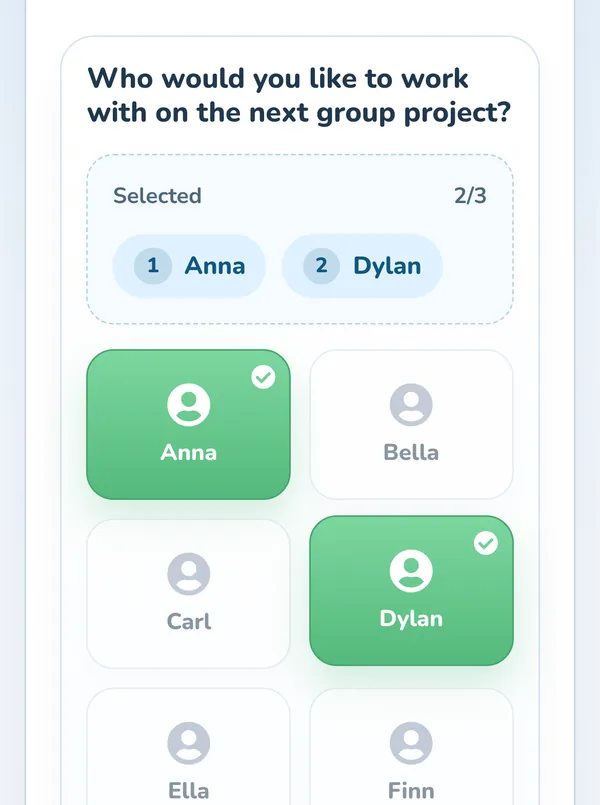
Laura, Class 8B's form tutor, is about to set up teams for the term project and has noticed some friction in class. Before forming the teams she runs a two-question test on students' phones in the last 15 minutes of a form period:
- Who would you like to work with on the next group project? (3 choices)
- Who would you rather not work with on the group project? (optional)
All 16 students answer. They make 48 choices and 15 rejections; only Chloe leaves the rejection question blank.
The answers
Each row is a student, with the three classmates they chose and the one they rejected. The last two columns add up what each student received from the others.
| Student | Chooses | Rejects | Choices received | Rejections received |
|---|---|---|---|---|
| Lucy | Mark, Sarah, Daniel | Ben | 7 | 0 |
| Mark | Lucy, Isaac, Sarah | Ben | 5 | 0 |
| Sarah | Lucy, Mark, Isaac | Alex | 4 | 2 |
| Isaac | Mark, Lucy, Sarah | Ben | 2 | 0 |
| Daniel | Lucy, Nora, Hugo | Ben | 5 | 0 |
| Nora | Hugo, Alice, Daniel | Alex | 3 | 0 |
| Hugo | Nora, Daniel, Alex | Ben | 5 | 0 |
| Alice | Nora, Leo, Alex | Ben | 2 | 0 |
| Leo | Hugo, Alice, Alex | Sarah | 2 | 0 |
| Martha | Paul, Irene, Lucy | Alex | 3 | 0 |
| Paul | Martha, Irene, Alex | Ben | 3 | 0 |
| Irene | Martha, Paul, Lucy | Alex | 2 | 0 |
| Alex | Leo, Paul, Hugo | Sarah | 4 | 6 |
| Ben | Daniel, Hugo, Mark | Alex | 1 | 7 |
| Chloe | Lucy, Sarah, Martha | — | 0 | 0 |
| Oscar | Daniel, Mark, Ben | Alex | 0 | 0 |
The sociogram
This is what Sociogram draws from those answers. Green arrows are choices (thicker when mutual); dashed red ones, rejections. Students nobody chose are shown in red.
Reading it, student by student
Lucy Popular
Chosen most (7 of 15) and never rejected. All three of her choices are mutual, and her mutual pair with Daniel links two subgroups.
Ben Rejected
7 rejections and a single choice (Oscar's). He chooses Daniel, Hugo and Mark, and all three reject him. The priority case.
Alex Controversial
4 choices and 6 rejections. Mutual ties with Leo, Hugo and Paul, but rejected by Sarah, Nora, Martha, Irene, Ben and Oscar. With Sarah the rejection is mutual.
Chloe and Oscar Neglected
Nobody chooses or rejects them. Chloe chooses Lucy, Sarah and Martha; Oscar, Daniel, Mark and Ben. Those choices show where they would like to fit in.
The indices
From the counts, each student's sociometric status is calculated (Coie, Dodge and Coppotelli's method; the procedure is explained in how to make a sociogram).
| Student | Choices | Rejections | Mutual | Choice status | Social preference (z) | Status |
|---|---|---|---|---|---|---|
| Lucy | 7 | 0 | 3 | 0.47 | +1.74 | Popular |
| Mark | 5 | 0 | 3 | 0.33 | +1.02 | Popular |
| Daniel | 5 | 0 | 3 | 0.33 | +1.02 | Popular |
| Hugo | 5 | 0 | 3 | 0.33 | +1.02 | Popular |
| Nora | 3 | 0 | 3 | 0.20 | +0.29 | Average |
| Martha | 3 | 0 | 2 | 0.20 | +0.29 | Average |
| Paul | 3 | 0 | 3 | 0.20 | +0.29 | Average |
| Sarah | 4 | 2 | 3 | 0.27 | +0.03 | Average |
| Isaac | 2 | 0 | 2 | 0.13 | -0.07 | Average |
| Alice | 2 | 0 | 2 | 0.13 | -0.07 | Average |
| Leo | 2 | 0 | 2 | 0.13 | -0.07 | Average |
| Irene | 2 | 0 | 2 | 0.13 | -0.07 | Average |
| Chloe | 0 | 0 | 0 | 0.00 | -0.79 | Neglected |
| Oscar | 0 | 0 | 0 | 0.00 | -0.79 | Neglected |
| Alex | 4 | 6 | 3 | 0.27 | -1.22 | Controversial |
| Ben | 1 | 7 | 0 | 0.07 | -2.62 | Rejected |
For the group: 71% reciprocity (34 of 48 choices returned) and 17 mutual pairs. Strong ties inside each subgroup, which makes the students left outside more visible.
What the reciprocity matrix adds
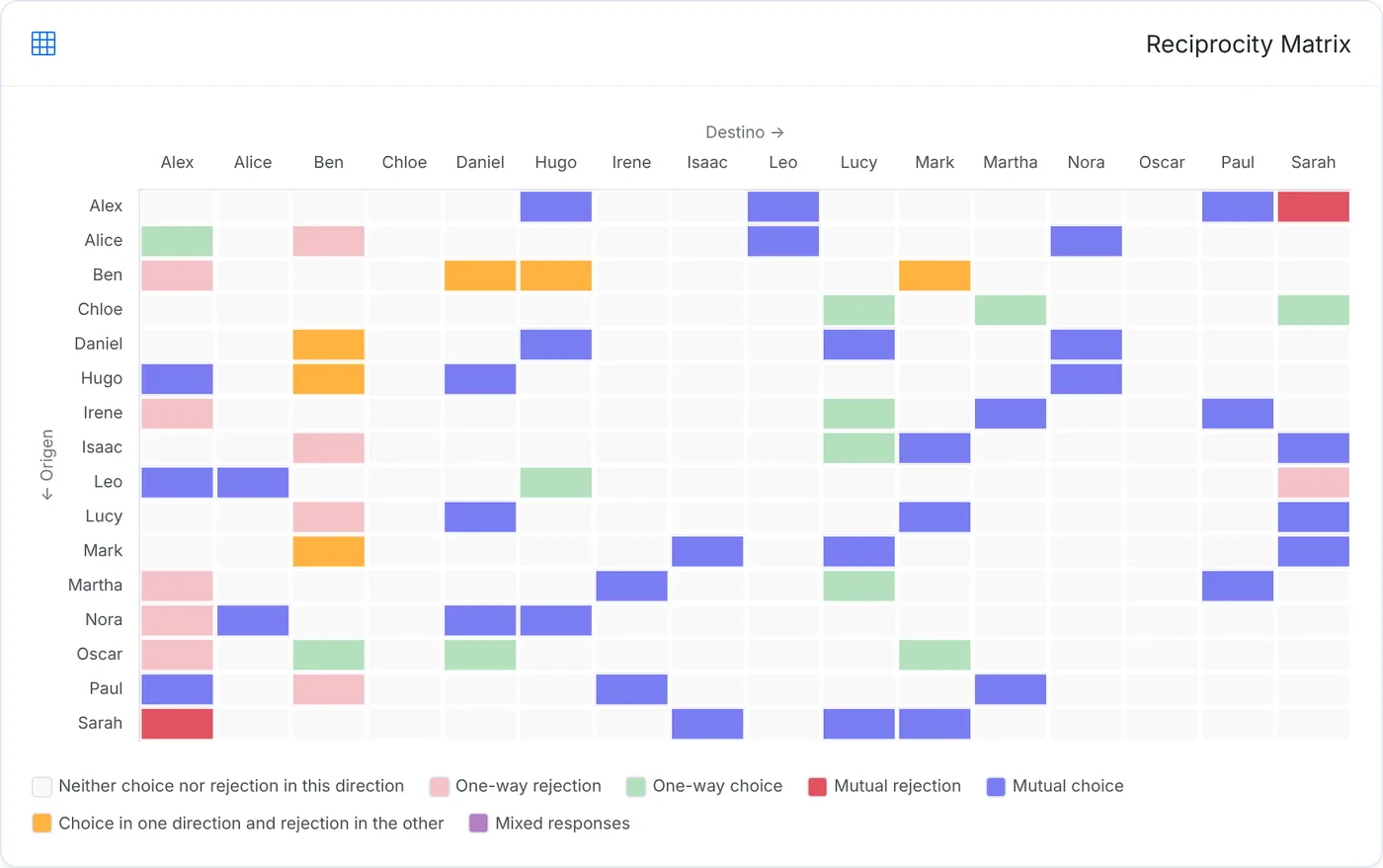
The sociogram shows who chooses whom; the reciprocity matrix shows what happens in each pair. It reveals something the chart hides: the three classmates Ben chooses all reject him (orange cells). It isn't just that they don't choose him; they don't want him on their team.
What the teacher decides
- Project teams: four teams of four that mix subgroups through the bridges (Lucy, Daniel, Alex). Chloe goes with Martha, whom she chose. Oscar with Daniel, whom he chose and who doesn't reject him.
- Ben: not placed with anyone who rejected him. He goes with Oscar, who chose him, and two classmates who didn't reject him. She talks to the school counsellor and watches how he is treated in class before taking any other step.
- Alex and Sarah: in different teams for this project.
- Follow-up: she will repeat the test at the end of term to compare.